Culture

Culture is the adhesive that binds a community together. From gastronomy to music, we provide the stories that give you a foundational understanding of Spain and Portugal.

Events

Catavino covers wine fairs, food events, cultural events and more, providing you a front row seat to exciting events across the peninsula.

Explore

Join us as we explore the world around us. Explore is a place for us to riff on ideas that don’t fit the Iberian wine mold, and allows us to share our travels around the globe! You never know what to expect in explore.

Food

Delicious and mouthwatering foods from across Iberia covering restaurant reviews, recipes, food and wine pairing, and the history of Spanish and Portuguese gastronomy.

Wine

Tasting notes, wine and regional profiles, wine book reviews, and breaking news in the Iberian wine industry allows your next wine purchase to be an informed one.

Home » Food

Dessert in Belem, Portugal? Pasteis de Belem of Course!

Submitted by Andrea on Wednesday, 16 July 200815 Comments |

You may not be aware of this, but the Portuguese are excellent bakers and pastry makers, each famed for their traditional local pastries! And because of this special culinary tradition, I wanted to dedicate a series to the stories behind each of these unique pastries, in addition to what dessert wines are commonly paired with them. I will try to do an installment every few weeks or for as long as my body can handle this much fat and sugar content! Although I typically avoid highly popular tourist destinations, Pasteis de Belem is an exception.

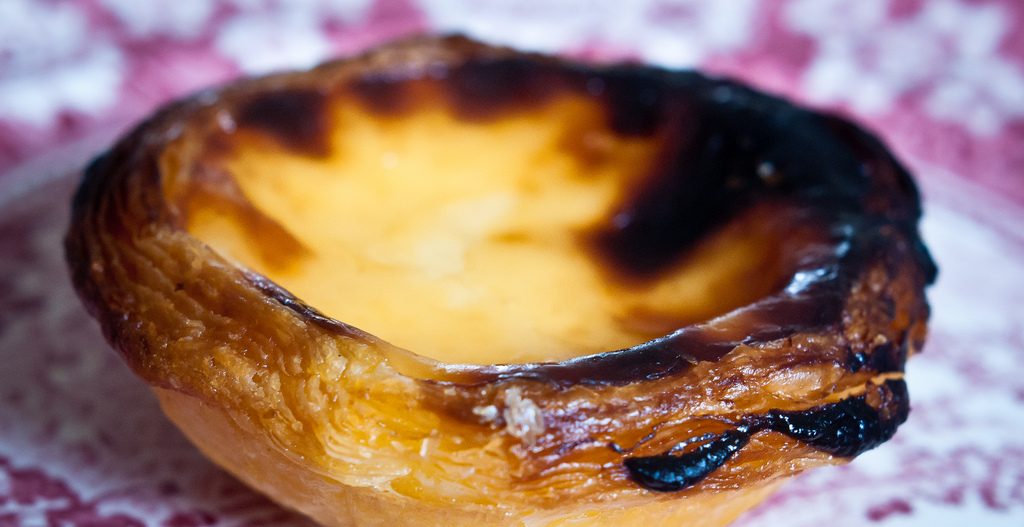
Pasteis are pastries in Portuguese, and the Pasteis de Belem is one of the oldest and most renowned in Portugal. The tradition dates back to the early 1800’s when the Mosteiro dos Jerónimos was shut down after the Liberal Revolution. Needing a means to survive, the monks used the sugar from the sugar cane refinery connected to the general store to produce sweet pastries. In 1837, they stopped selling through the general store to open a bakery, catering to both locals and visiting steamboat tourists alike. These mini egg-custard pies with a crisp, flaky crust are made from the monk’s ancient, top-secret recipe. It has remained unchanged, passed down only to the master bakers, who still hand-craft them in the “secret room” in the bakeshop. The Pasteis are normally served warm out of the oven and lightly sprinkled with sugar and cinnamon.

Today, the Pasteis de Belem bakeshop is still hugely popular. And though it may look small from the outside, it is quite extensive and windy in the back, with many individual dining rooms decorated with old traditional Portuguese blue and white tile art. Yet, despite its size, the lines on the weekend go all the way out the shop into the street! I was smart this time to come on a weekday night. And since there’s no menu, as they only serve Pasteis de Belem, you’re only job is to decide how many and what to drink with them. I asked my waiter to bring me a wine that is typically drunk with the pastry. Judging from the vast number of Port bottles displayed on the shelves, it was no surprise when he came back with a glass of Ferreira Dona Antonia Reserva Port. Aged 8 years in oak casks, this port has the ripe fruits of a Ruby with the nuttiness and spice of a Tawny. A.A. Ferreira happens to be one of the best-selling Ports in Portugal, and also one of the oldest houses, so I could see how it might pair well. However, it had such a powerful, spicy finish that it literally overwhelmed my palate, masking the lighter, creamier flavors of the Pasteis. Port may be the traditional pairing with this pastry, but I would suggest a Moscatel de Setubal from JP Vinhos, or Jose Maria da Fonseca, which are smoother and sweeter, but still match the richness of the creme-brulee like Pasteis.

Andrea’s Tip: you can find the generic version of Pasteis de Belem called, Pasteis de Nata, all around Lisbon. So don’t make the mistake of asking for Pasteis de Belem outside of their bakeshop! It’s still good, but not as good as the original.

To the sweet little things,

Andrea Smith

Reblog this post [with Zemanta]

15 Comments »

  • sandy says:

    I have always eaten Egg Custard Tarts in Chinese restaurants that serve Dim Sum. They are very similar to these Portuguese egg tarts except they are not caramelized on top. Apparently these Portuguese egg tarts are ancestors of these Chinese egg tarts (see http://en.wikipedia.org/wiki/Egg_tart). “>http://en.wikipedia.org/wiki/Egg_tart). When these Portuguese egg tarts were (re-)introduced to Hong Kong, Taiwan, Malaysia and Singapore in the late 1990's, it caused a big craze and people would line up outside of bakeries to buy them. It was like everyone had try them to see if there was a difference between the Chinese version and the Portuguese version. I was one of them. Subsequently the craze died down, and you can find these Portuguese tarts only in a handful of bakeries in the region. Only the Chinese version is still widely available in just about all the bakeries.

  • sandy says:

    I have always eaten Egg Custard Tarts in Chinese restaurants that serve Dim Sum. They are very similar to these Portuguese egg tarts except they are not caramelized on top. Apparently these Portuguese egg tarts are ancestors of these Chinese egg tarts (see http://en.wikipedia.org/wiki/Egg_tart). “>http://en.wikipedia.org/wiki/Egg_tart). When these Portuguese egg tarts were (re-)introduced to Hong Kong, Taiwan, Malaysia and Singapore in the late 1990's, it caused a big craze and people would line up outside of bakeries to buy them. It was like everyone had try them to see if there was a difference between the Chinese version and the Portuguese version. I was one of them. Subsequently the craze died down, and you can find these Portuguese tarts only in a handful of bakeries in the region. Only the Chinese version is still widely available in just about all the bakeries.

  • sandy says:

    I have always eaten Egg Custard Tarts in Chinese restaurants that serve Dim Sum. They are very similar to these Portuguese egg tarts except they are not caramelized on top. Apparently these Portuguese egg tarts are ancestors of these Chinese egg tarts (see http://en.wikipedia.org/wiki/Egg_tart). “>http://en.wikipedia.org/wiki/Egg_tart). When these Portuguese egg tarts were (re-)introduced to Hong Kong, Taiwan, Malaysia and Singapore in the late 1990's, it caused a big craze and people would line up outside of bakeries to buy them. It was like everyone had try them to see if there was a difference between the Chinese version and the Portuguese version. I was one of them. Subsequently the craze died down, and you can find these Portuguese tarts only in a handful of bakeries in the region. Only the Chinese version is still widely available in just about all the bakeries.

  • sandy says:

    I have always eaten Egg Custard Tarts in Chinese restaurants that serve Dim Sum. They are very similar to these Portuguese egg tarts except they are not caramelized on top. Apparently these Portuguese egg tarts are ancestors of these Chinese egg tarts (see http://en.wikipedia.org/wiki/Egg_tart). “>http://en.wikipedia.org/wiki/Egg_tart). When these Portuguese egg tarts were (re-)introduced to Hong Kong, Taiwan, Malaysia and Singapore in the late 1990's, it caused a big craze and people would line up outside of bakeries to buy them. It was like everyone had try them to see if there was a difference between the Chinese version and the Portuguese version. I was one of them. Subsequently the craze died down, and you can find these Portuguese tarts only in a handful of bakeries in the region. Only the Chinese version is still widely available in just about all the bakeries.

  • Gabriella Opaz says:

    So out of curiosity Sandy, do you prefer the Chinese version or the Portuguese version? And do the Chinese pair tea with this dessert or is there a traditional beverage that you serve with it?

  • sandy says:

    The Chinese decides if it is a good custard by how flaky the shell and how light and smooth the custard is. The custard of the Portuguese version was a bit denser than the Chinese version. Other than that, they are quite similar. I prefer the bite-sized light and fluffy Chinese custards with a good pot of Chinese tea. Oh, did I say tea? I meant a glass of good Spanish wine…. :)

  • Andrea Smith says:

    Hmmm I have to try the Chinese version now! Thanks Sandy!

  • Vitor Mendes says:

    Yes, they are great… and it is correct, although we have this kind of pastries all over Portugal, the original ones are the best, indeed. Great post Andrea, and i also think that maybe a Moscatel would be more correct with the kind of sweeteness and texture that pastéis de belém have. About the Chinese copy, well i have to try it sometime, but you know… the original is allways the original, the other are allways variations… sorry…

  • Troy says:

    I agree with all of Andrea's comments, except the Pasteis de Belem facility does have a limited menu (sandwiches and the like). The pastry counter also sells — but doesn't make — dozens of other pastries as well.

  • troy says:

    oh, and while this is a wine blog, i've found that the best pairing with the pasteis is either an espresso (let the bitterness of coffee be tempered with the sweetness of the custard) or their home-made hot chocolate (in which case you should swear off desserts for a week, at least; the hot chocolate is just pure melted chocolate). i take my kids there all through the winter. while we're at it, though, i'll bet the queijoadas from sintra could hold up to that port. can that be your next installment?

  • [...] walking around in Medieval Portugal in the delightful company of Andrea Smith, features writer for CataVino, and strolling around the village I find myself indirectly looking for toys for my puppy…. [...]

  • [...] to granddaughters in family-run pastelerias. Other than the most famous Portuguese pastry, Pastel de Nata,  some popular pastries also include French inspired Palmiers, Napoleões (Napoleans) and [...]

  • oh! taste looks good,i feel hungry and starve to death upon reading the article,how i wish i could eat a lot more.

  • [...] must say, I never get a chance to shop in Portugal on my travels, but I did stay next door to Pasteis de Belem in Lisbon on a recent trip and who can resist their 6 pack of still warm custard tarts with a [...]

  • [...] lunch walk back across the street to have your dessert and coffee or glass of Port at the famous Pasteis de Belém to savor their historically popular egg tarts. You can assume there will be a line, but it’s [...]

Leave a comment!

Add your comment below, or trackback from your own site. You can also subscribe to these comments via RSS.

Be nice. Keep it clean. Stay on topic. No spam.

You can use these tags:
<a href="" title=""> <abbr title=""> <acronym title=""> <b> <blockquote cite=""> <cite> <code> <del datetime=""> <em> <i> <q cite=""> <strike> <strong>

This is a Gravatar-enabled weblog. To get your own globally-recognized-avatar, please register at Gravatar.